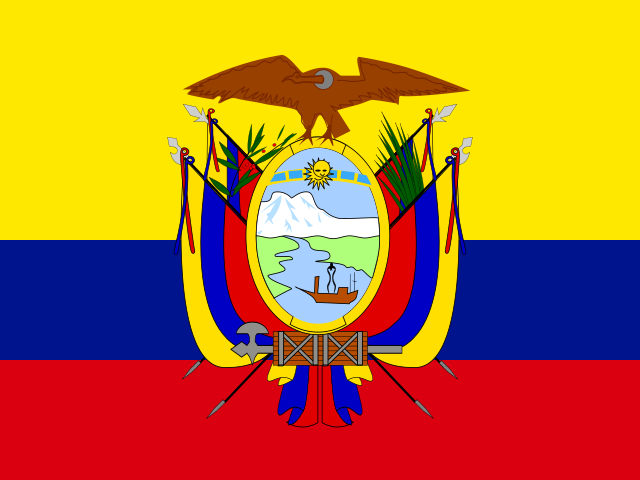

Ecuador vs Bolivia
Compare Ecuador and Bolivia corporate tax rates, filing due dates, withholding tax, VAT, capital gains tax, and effective tax metrics for cross-border company planning.
Time of Update — Ecuador: 4/06/2026 · Bolivia: 4/01/2026 Ecuador
 Bolivia
Basic Corporate Tax Comparison
Time of Update — Ecuador: 4/06/2026 · Bolivia: 4/01/2026Corporate Income Tax (CIT)
EcuadorBoliviaGeneral CIT Rate:
Corporate Income Tax (CIT) rates vary depending on the company’s shareholder structure and disclosure compliance, with rates of 22%, 25%, or 28%.
General CIT Rate:
25%(except for mining, financial institutions, and insurance/reinsurance companies, which have an additional income tax rate)
CIT Return Due Date:
Between April 9 and April 28 each year.
CIT Return Due Date:
120 days after the fiscal year-end.
CIT Payment Due Date:
Between April 9 and April 28 each year.
CIT Payment Due Date:
120 days after the fiscal year-end.
CIT Estimated Payment Due Date:
NA
CIT Estimated Payment Due Date:
NA
Withholding Tax (WHT)
EcuadorBoliviaResident Withholding Tax (Dividend/Interest/Royalty):
0/2/10
Resident Withholding Tax (Dividend/Interest/Royalty):
0/0/0
None-Resident Withholding Tax (Dividend/Interest/Royalty):
10/25/25
None-Resident Withholding Tax (Dividend/Interest/Royalty):
12.5/12.5/12.5
Value-Added Tax (VAT)
EcuadorBoliviaCapital Gain Tax (CGT)
EcuadorBoliviaGeneral Capital Gain Tax Rate:
Gains from the transfer of equity rights, such as shares, are taxed at a rate of 10%.
General Capital Gain Tax Rate:
Capital gains are subject to the normal CIT rate:25%.
Effective Tax Rate (ETR)
EcuadorBoliviaComposite Effective Average Tax Rate:
23.34%
Composite Effective Average Tax Rate:
27%
Composite Effective Marginal Tax Rate:
18.60%
Composite Effective Marginal Tax Rate:
25%–26%


 Global - Español
 Argentina - Español
 Chile - Español
 Colombia - Español
 Costa Rica - Español
 España - Español
 Estados Unidos - Español
 Mexico - Español
 Panama - Español
 Peru - Español
 Union Europea - Español
 中国内地 - 简体中文
 新加坡 - 简体中文
 泰国 - 简体中文
 澳大利亚 - 简体中文
 马来西亚 - 简体中文
 澳門特區 - 繁體中文
 香港特區 - 繁體中文